|
Written by Hugh Morrison
|
|
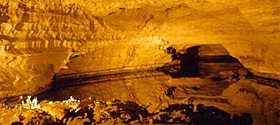 Cocklebiddy LakeThe current era of diving on the plain was ushered in during 1972 with Ian Lewis and other South Australians systematically diving in some of the then 10 known caves with lakes. A total of 500 metres of underwater passages were found but limited organisation prevented further exploration. It must be added that at this time, the largest penetration dive attempted in Australia had been carried out by the Underwater Explorer's Club of Tasmania in Kubla Khan, a distance of 502 metres. Cocklebiddy LakeThe current era of diving on the plain was ushered in during 1972 with Ian Lewis and other South Australians systematically diving in some of the then 10 known caves with lakes. A total of 500 metres of underwater passages were found but limited organisation prevented further exploration. It must be added that at this time, the largest penetration dive attempted in Australia had been carried out by the Underwater Explorer's Club of Tasmania in Kubla Khan, a distance of 502 metres.
Over the Christmas-New Year of 1973/74 the second Nullarbor cave diving expedition proceeded to dive in all the remaining wet caves except Winbirri, which couldn't be found. At this stage the divers were using only single tanks, 6 volt sealed beam lights and reels which could only be described as archaic. However, the two divers, Ian Lewis and Keith Deckers, were still able to add 1300 metres more to existing caves and, in particular, the spectacular Tommy Graham's system.
|
|
Written by Ron Doughton
|
|
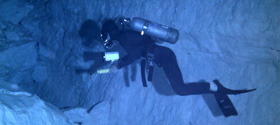 In 1971-72 the first diving Nullarbor Caves Expedition took place with Phil Prust, Dave Warnes, Ian Lewis, Bob Lea, Bob Turnbull, and Ron and Denyse Doughton from Sydney. The divers were supported by dry cavers from CEGSA, WASG, Rover Scouts and others. A total party of about 60!, although not all were out on the Nullarbor at the same time. The 10 known caves with lakes were systematically dived and a total of 500 metres of underwater passages were found. These caves included Weebubbie Cave, Cocklebiddy Cave, Pannikin Plains Cave, Tommy Grahams Cave, Murra-El-Elevyn Cave and Mullamullang Cave. In 1971-72 the first diving Nullarbor Caves Expedition took place with Phil Prust, Dave Warnes, Ian Lewis, Bob Lea, Bob Turnbull, and Ron and Denyse Doughton from Sydney. The divers were supported by dry cavers from CEGSA, WASG, Rover Scouts and others. A total party of about 60!, although not all were out on the Nullarbor at the same time. The 10 known caves with lakes were systematically dived and a total of 500 metres of underwater passages were found. These caves included Weebubbie Cave, Cocklebiddy Cave, Pannikin Plains Cave, Tommy Grahams Cave, Murra-El-Elevyn Cave and Mullamullang Cave.
|
|
Written by Chris Brown and Tony Richardson
|
|
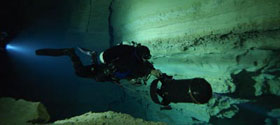 1961: First dive in Cocklebiddy by divers from Western Australia Speleological Group (WASG). Managed to establish that there was a submerged tunnel, 200 metres from the cave entrance, but were unable to swim much distance due to lack of gear. 1961: First dive in Cocklebiddy by divers from Western Australia Speleological Group (WASG). Managed to establish that there was a submerged tunnel, 200 metres from the cave entrance, but were unable to swim much distance due to lack of gear.
1972: First large scale expedition. Adelaide divers were Ian Lewis, Phil Prust, Dave Warnes and Bob Turnbull while Bob Lea, and Ron and Denyse Doughton were from Sydney. Several hundred metres of line were laid in a northward direction.
|
|
Last Updated on Wednesday, 04 January 2023 13:37 |
|
Wednesday, 11 August 2010 09:29 |
|
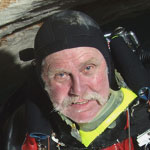 Dave Warnes has been cave diving for about 50 years. At age 75 he is the oldest active cave diver in Australia. Dave Warnes has been cave diving for about 50 years. At age 75 he is the oldest active cave diver in Australia.
Dave started cave diving in the Lower South East in the 1960's. He sat on the steering committee for the development of cave diving standards after a series of cave diving fatalities in the late 60's and early 70's. Dave was elected the founding president of the Cave Divers Association of Australia and holds life membership with that organisation. He was responsible for discovery and exploration of a number of caves in the Lower South East and on the Nullarbor.
|
|
Written by Tony Richardson
|
|
This series of articles chronicles the history of exploration in Tank Cave (a work in progress):
Tank Cave ... the exploration continues
|
|
|
|
|
|
